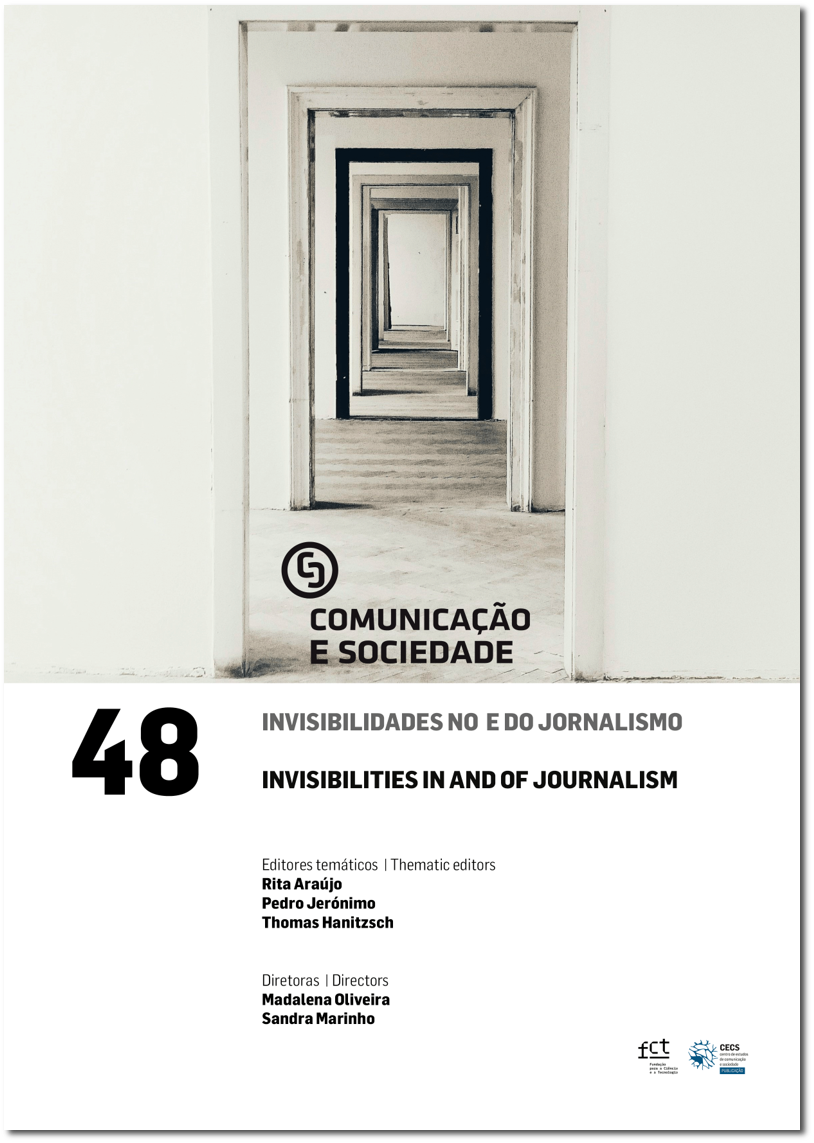
Nota Introdutória: Invisibilidades no e do Jornalismo
DOI:
https://doi.org/10.17231/comsoc.48(2025).7061Downloads
Referências
Adams, C. (2018). “They go for gender first”: The nature and effect of sexist abuse of female technology journalists. Journalism Practice, 12(7), 850–869. https://doi.org/10.1080/17512786.2017.1350115
Araújo, R. (2024). Who wants to be a journalist? Journalists’ exposure to violence on the job. Journalism Practice, 1–15. https://doi.org/10.1080/17512786.2024.2433633
Araújo, R. (2025). Insulted and outraged: How do Portuguese journalists experience precarity. Journalism. Advance online publication. https://doi.org/10.1177/14648849251314786
Chen, G. M., Pain, P., Chen, V. Y., Mekelburg, M., Springer, N., & Troger, F. (2020). ‘You really have to have a thick skin’: A cross-cultural perspective on how online harassment influences female journalists. Journalism, 21(7), 877–895. https://doi.org/10.1177/1464884918768500
Cohen, N. S., Hunter, A., & O’Donnell, P. (2019). Bearing the burden of corporate restructuring: Job loss and precarious employment in Canadian journalism. Journalism Practice, 13(7), 817–833. https://doi.org/10.1080/17512786.2019.1571937
Deuze, M. (2009). What is journalism? Professional identity and ideology of journalists reconsidered. Journalism, 6(4), 442–464. https://doi.org/10.1177/1464884905056815
Ekdale, B., Rinaldi, A., Khanjani, M., Matanji, F., & Stoldt, R. (2022). Geographic disparities in knowledge production: A big data analysis of peer-reviewed communication publications from 1990 to 2019. International Journal of Communication, 16, 2498–2525.
Ekdale, B., Tully, M., Harmsen, S., & Singer, J. B. (2015). Newswork within a culture of job insecurity. Journalism Practice, 9(3), 383–398. https://doi.org/10.1080/17512786.2014.963376
Gollmitzer, M. (2014). Precariously employed watchdogs? Journalism Practice, 8(6), 826–841. https://doi.org/10.1080/17512786.2014.882061
Goyanes, M., & Demeter, M. (2020). How the geographic diversity of editorial boards affects what is published in JCR-ranked communication journals. Journalism & Mass Communication Quarterly, 97(4), 1123–1148. https://doi.org/10.1177/1077699020904169
Hanitzsch, T. (2019). Journalism studies still needs to fix Western bias. Journalism, 20(1), 214–217. https://doi.org/10.1177/1464884918807353
Hanusch, F., & Vos, T. P. (2020). Charting the development of a field: A systematic review of comparative studies of journalism. International Communication Gazette, 82(4), 319–341. https://doi.org/10.1177/1748048518822606
Holton, A. E., Bélair-Gagnon, V., Bossio, D., & Molyneux, L. (2023). “Not their fault, but their problem”: Organizational responses to the online harassment of journalists. Journalism Practice, 17(4), 859–874. https://doi.org/10.1080/17512786.2021.1946417
Ivask, S., Waschková Císařová, L., & Lon, A. (2023). “When can I get angry?” Journalists’ coping strategies and emotional management in hostile situations. Journalism, 25(10), 2099–2116. https://doi.org/10.1177/14648849231199895
Jerónimo, P., & Torre, L. (2025). Local journalism in the digital age: A systematic review of a decade of research. Texto Livre, 18, 1–21. https://doi.org/10.1590/1983-3652.2025.59031en
Kovach, B., & Rosenstiel, T. (2004). Os elementos do jornalismo (J. Fidalgo & M. Pinto, Eds.). Porto Editora. (Trabalho original publicado em 2003)
Matthews, J., & Onyemaobi, K. (2020). Precarious professionalism: Journalism and the fragility of professional practice in the Global South. Journalism Studies, 21(13), 1836–1851. https://doi.org/10.1080/1461670X.2020.1797524
Mesquita, M. (2003). O quarto equívoco. O poder dos media na sociedade contemporânea. Minerva.
Miller, K. C. (2023). Hostility toward the press: A synthesis of terms, research, and future directions in examining harassment of journalists. Digital Journalism, 11(7), 1230–1249. https://doi.org/10.1080/21670811.2021.1991824
Miller, K. C., & Lewis, S. C. (2022). Journalists, harassment, and emotional labor: The case of women in on-air roles at US local television stations. Journalism, 23(1), 79–97. https://doi.org/10.1177/1464884919899016
Miranda, J., Silveirinha, M. J., Sampaio-Dias, S., Dias, B., Garcez, B., & Noronha, M. (2023). “It comes with the job”: How journalists navigate experiences and perceptions of gendered online harassment. International Journal of Communication, 17, 5128–5148.
Örnebring, H. (2018). Journalists thinking about precarity: Making sense of the “new normal”. #ISOJ Journal, 8(1), 109–127.
Rick, J. (2025). Acutely precarious? Detecting objective precarity in journalism. Digital Journalism, 13, 542–561. https://doi.org/10.1080/21670811.2023.2294995
Ricketson, M., Dodd, A., Zion, L., & Winarnita, M. (2020). “Like being shot in the face” or “I’m glad I’m out”: Journalists’ experiences of job loss in the Australian media industry 2012–2014. Journalism Studies, 21(1), 54–71. https://doi.org/10.1080/1461670X.2019.1627899
Singer, J. B. (2003). Who are these guys? The online challenge to the notion of journalistic professionalism. Journalism, 4(2), 139–163. https://doi.org/10.1177/1464884903004002021
Slavtcheva-Petkova, V., Ramaprasad, J., Maheshwari, M., Weglinska, A., Konarska, K., Hoxha, A., Relly, J., Springer, N., Moreira, S. V., Visnovsky, J., & González de Bustamante, C. (2025). Safety and work-related risks. Worlds of Journalism. https://www.worldsofjournalism.org/wp-content/uploads/WJS3-Report-Safety-and-Work-related-Risks.pdf
Sybert, J. (2023). Navigating precarity: Disruption and decline at the Pittsburgh Post-Gazette. Journalism Practice, 17(4), 737–754. https://doi.org/10.1080/17512786.2021.1939105
Wahl-Jorgensen, K., & Hanitzsch, T. (2009). The handbook of journalism studies. Routledge.
Waisbord, S. (2022). Can journalists be safe in a violent world? Journalism Practice, 16(9), 1948–1954. https://doi.org/10.1080/17512786.2022.2098524
Zelizer, B. (2012). On the shelf life of democracy in journalism scholarship. Journalism, 14(4), 459–473. https://doi.org/10.1177/1464884912464179
Downloads
Publicado
Edição
Secção
Licença
Direitos de Autor (c) 2025 Rita Araújo, Pedro Jerónimo, Thomas Hanitzsch

Este trabalho encontra-se publicado com a Licença Internacional Creative Commons Atribuição 4.0.
Os autores são titulares dos direitos de autor, concedendo à revista o direito de primeira publicação. O trabalho é licenciado com uma Licença Creative Commons - Atribuição 4.0 Internacional.